
FOR THE LOVE OF MAKING IT

Discipline is All You Need // A three-part essay by Peter Urban
Compounding Knowledge Debt
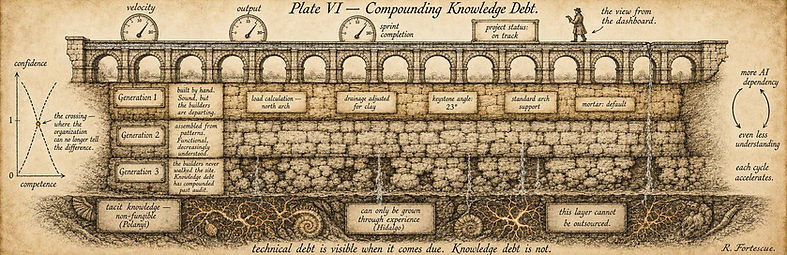
This cumulative effect needs a name, because naming a problem is the first step toward solving it. Most leaders understand technical debt. Shortcuts in code that save time now and cost time later. Technical debt is visible when it comes due. The system slows down, bugs multiply, and deployments get painful. With technical debt, you can point to the code and say, " This is what needs to be fixed.”
Structural knowledge debt is the organizational equivalent and it is far more dangerous. Knowledge debt is what accumulates when you take shortcuts in understanding, when output ships but comprehension doesn't form and grow. Every AI-generated module that enters your codebase without a human building a genuine mental model of how it works is a deposit into your knowledge debt account.
At first, the interest rate is invisible, until something breaks, until someone leaves, or until requirements change. Then you discover the balance, and it can be ruinous, depending on how far your teams have gone down this path.
Knowledge debt is worse than technical debt for a specific reason. It's self-reinforcing. The less the team understands the codebase and its underlying architecture, the more they depend on AI to modify it. The more they depend on AI, the less they understand. This is the loop; each cycle turns faster than the last, and the variable-ratio reward schedule ensures that every turn continues to feel like progress. Confidence rises as competence falls, and the project dashboard continues to glow green.
Non-Fungible Knowledge
César Hidalgo, a researcher who studies how knowledge moves through economies, made this the title of a formal academic paper: "Knowledge Is Non-Fungible." His analysis is precise; knowledge cannot be transferred like a file or swapped like a commodity. It can only be grown through experience, because the process of learning is itself non-reducible. Michael Polanyi made the same point decades earlier in his work on tacit knowledge. The most critical knowledge in any skilled practice is the kind that can't be written down. It can only be acquired through doing. "We know more than we can tell," Polanyi wrote.
If they're right, and the evidence strongly suggests they are, then organizations that outsource cognitive work to AI may be saving time at first, but they are also eliminating the conditions under which their most important knowledge forms. The understanding that makes your team valuable isn't stored in your codebase or your documentation; it's stored in your people, and it only gets there through the friction of people doing the work.
While you can outsource the typing and you can outsource the syntax, you cannot outsource the process that creates the understanding. An organization that stops building understanding doesn't just slow down. It starts dying, quietly, invisibly, from the inside out.
And no AI is going to save it.
The Scarcest Resource in the Age of AI

Part 1 has established that AI coding tools operate on the same variable-ratio reinforcement schedule that makes gambling addictive. They produce a counterfeit state, flow's shadow brother, that feels like productive absorption but displaces the conditions under which engineers actually grow. What erodes is invisible to every metric your organization tracks. What compounds is a loop of declining capability that feels, from the inside, like progress.
The Google Brain paper that launched the AI revolution was called "Attention Is All You Need." In the context of machine learning, the paper described a mathematical mechanism for selective focus, amplifying the signals that matter and thereby filtering the noise. It turned out to be one of the most important architectural insights in the history of artificial intelligence.
The same principle applies to every organization now using that technology. But the attention that matters here isn't computational; it's human, it’s leaders seeing what no standard metric captures. It is the attention of engineers and managers to understand the problems behind the code, behind the product, behind any knowledge work that matters. It is organizations regularly and systematically asking the only question that matters in the long run: Are we actually getting better, or are we just getting 'faster'?
In the age of AI, true human attention and understanding are the scarcest resources you have. The discipline to protect them is the only strategy that contributes to lasting success and growth.
Everything else is just blind lever-pulling.
Naming the principle of discipline to protect and maintain the right kind of attention is the easy part. What comes next is harder. The same dynamics that reshape individual developers are now operating at scale across teams, leadership perception, and organizational knowledge. Knowing the principle doesn't mean being able to follow it, because the forces pulling against it are structural, not motivational.
That's where Part 2 begins. Coming soon - sign up for my newsletter below to be notified.
Next up: References and Sources - Part 1

PART 1 SEGMENTS
0
1
2
3
4
5
Get "Discipline is All You Need" as A Printable PDF
And Be Notified When Part 2 Drops.
Sign up to my newsletter. Carefully written and beautifully crafted tech & business leadership treasures, semi-regularly in your inbox free of charge.
Bonus Feature: I'll never sell your email address.